A romantic Teaninich: peated flavours from the floor
Our periodical entries about bottlings in the Rare Malts Selection become increasingly … rare, but we managed to unearth another expression! Today, we sink out teeth into a truly special distillery called Teaninich. Known to connoisseurs mostly, Teaninich is not to be overlooked, as it often offers a special take on what single malt is. How this comes to be, I will explain down below, while we gear up for tasting a 1973 specimen!
Current-day Teaninich is a mammoth distillery with a capacity of well over 10 million litres per annum. It plays in the big league together with their not so far away neighbour Glen Ord. But where the latter has a bright day in the spotlight, Teaninich remains an obscure name. Producing liquid for the big blends in the Diageo portfolio, this over 200 years old distillery belongs to the shadows. True whisky nerds will know the one technical asset that makes the distillery stand out, which is the use of a hammer mill for grinding the malted barley, and a mash filter to convert the starch into sugar. This allows for more variation in which mash bill to produce. In the Special Releases of 2025 we therefor saw the entry of a Teaninich Rye variant. Of course, the Scotch Whisky Association does not allow a mention of that on the label, so this Teaninich had to be released as a single grain whisky. Quite the anomaly, even if the resulting whisky was not too spectacular.
Experimenting is modern, but Teaninich is not without history. The distillery was founded in 1817 by a Captain Hugh Munro. It is safe to say that this did not bring distilling to the Alness area, it merely legalised what was happening already. The name Teaninich can be led back to meaning something like “house on the moor”, which makes me think of Wuthering Heights straight away, even though we are far from Yorkshire here. Indeed, Alness is home to the Dalmore Distillery and nearby we can also find Glenmorangie. Teaninich was a solution to a big problem in the area. So much illegal distilling was going on, that a famine loomed, as all the grain for bread actually went into the stills. The distillery prospered, and with more regulation, the illicit stills went out of business soon enough.
The Munro family held the helm for decades, leasing the distillery after Hugh’s dead to the infamous Robert Pattison, a bit of a Donald Trump of his day. The next person to lease Teaninich was John McGilchrist, who was something of a Nicola Tesla (as long as we are comparing), thus making the distillery one of the first to have electric power, light and a telephone system. This was chronicled by the famous whisky journalist Alfred Barnard. Near the turn of the century, ownership structure is a bit messy to see through, but in 1904 we see one Robert Ian Cameron become the sole proprietor of Teaninich. This man, a whisky broker, at that point already owns (parts of) Benrinnes, Linkwood and Tamdhu. The reign lasted almost 30 years, before Teaninich was swallowed into Distiller Company Ltd (DCL). Now you know how it ended up in current day Diageo.
Fast forward to after the big wars of the twentieth century. Teaninich restarted production with only two of the available four stills. Only in 1962 the numbers returned to four. From this moment, the firing of the equipment also changed from direct coal fire to indirect heating. From here on out, the setup becomes dodgy, as we have seen a few more examples of in Scotland. All facilities like mashing and milling were carried out in a new building constructed in 1973-’74. Even though this featured like a distillery inside a distillery, it was referred to as Teaninich B. Because a new complex had already been built in 1969 in an architectural style like you can also see at for instance Caol Ila and Clynelish, there also existed a Teaninich A. Here were 12 stills operating to produce a lot of malt whisky for blends. The operation slowly disappeared over the course of the following decades, with closures and mothballing going on in the 1980s. Teaninich A came back in production in 1991 but the B-side never worked again and was demolished in 1999.
Teaninich had a peaty backbone in the old days, but when floor malting (on a solid clay floor) was abandoned in 1973, malt came in via Glen Ord. The locally cut peat from the nearby moors was a thing of the past, because the malt became unpeated from that point onwards. An interesting question about the sample we will taste today, is if this was still whisky produced from the floor maltings, or already the unpeated style. We will keep an eye out!
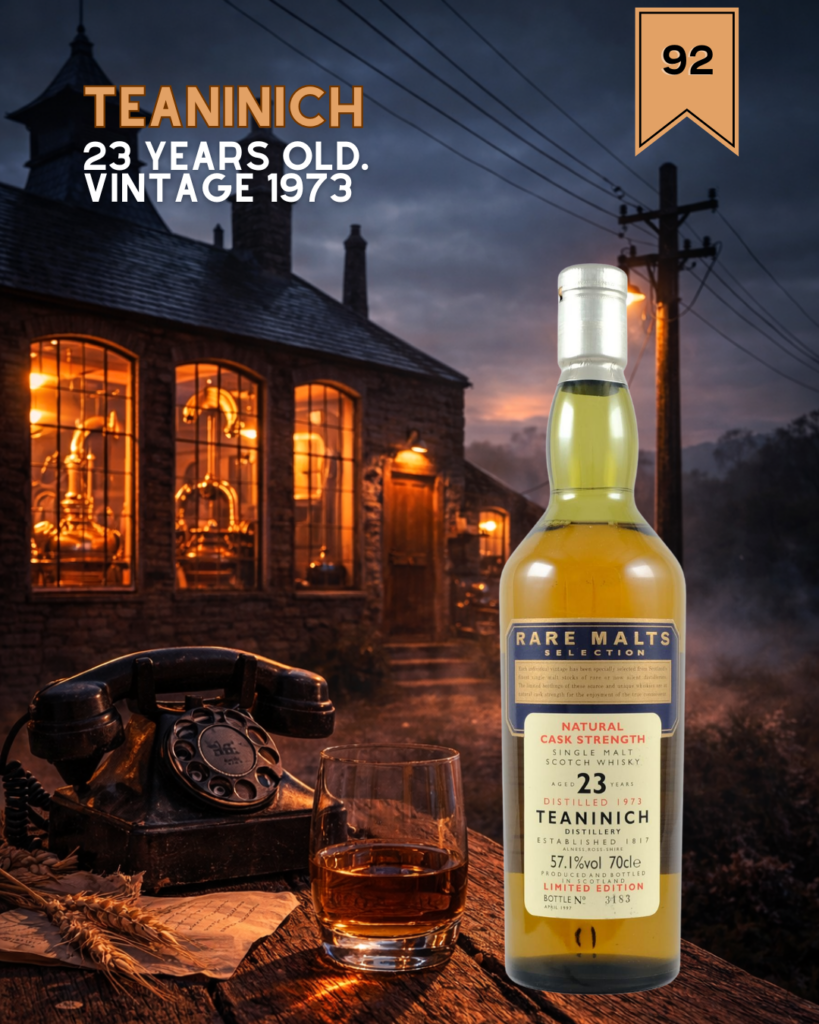
Teaninich 23 years old. vintage 1973, bottled at 57,1 % abv
First things first: Bottled in April 1997, almost 30 years ago. This is one of only three different releases of Teaninich in the Rare Malts Selection, the other two being from the 1972 vintage at 23 and 27 years old (not counting different size bottles for these releases). The original cask management was based on a 10 years old, on bourbon casks and sherry butts. Most whisky was destined to be a building block in brands like Johnnie Walker, Vat 69 and Haig. Also the Drambuie liquor featured a healthy dose of Teaninich.
Upon Sipping: Bottled at 100 proof, this is certainly not too hot, and releases a lot of farmland smells. Like dry hay, you can just see the tractors working the field, cutting the barley and forming it into hay bales. Then there are hints of dry mud sticking to giant rubber tyres. In the distance more familiar notes of soft oak, sharp custard, lemon drizzle and sweet vanilla. Some tree bark and dry moss. Yes, dry is the operative word here, this all breathes the influence of a bright summer day. Let’s see if the taste is dry too!
A more rough character to take on the palate, I have to say, but very impressive on delivering an old school vibe. This is true classic single malt whisky, in a way you do not come across often these days. If at all. Indeed, a dry palate, but balanced out with decent oaky notes and hints of overripe fruit, like dark banana and mulchy peach. Some hints of oranges too. A delicate whiff of cigarette smoke lingers on the tongue.
With water, hints of petrichor, so the summer’s day is still in our story, but now it rained. The palate suffers a little from the dilution, but it does bring out more layers of taste, with a copper note to begin with, and a surprisingly big dose of wood mulch and … peat?
Does this answer our question if this was still made with some peated, floor malted production? My romantic side forces me to say yes, embrace it, enjoy the fruits of the labour of hard working Scottish distillery workers. It is certainly not unthinkable. These kind of flavours come from men’s handy work, not a machine regulated production. This Teaninich 23 years old from 1973 carries a good deal of Scotch soul.
Word to the Wise: Not an easy dram, one to work with, but oh so rewarding if you take your time and embrace the otherness of this Teaninich Rare Malts Selection. It is a time machine single malt whisky, displaying elements we savour but have lost over the decades. This might sound weird for a Rare Malts whisky, but avoid water, it is better without.
Score: 92 points.