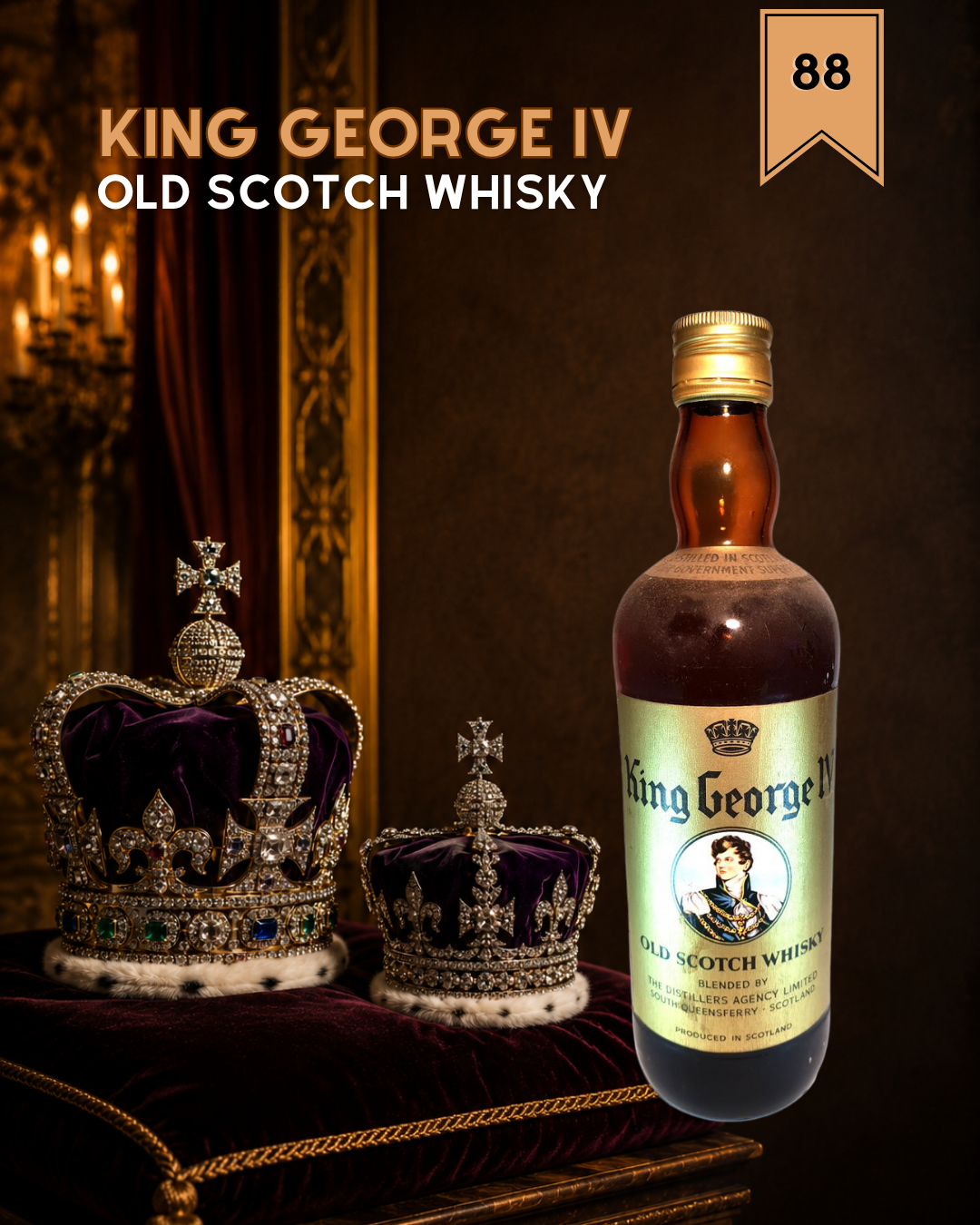
Blended Scotch with Royal ties from yesteryear
The Royal Houses of the United Kingdom of Great Britain and Ireland always had strong ties with the Scotch whisky industry. There are all kinds of blends named after (in)famous Kings and Queens, most times on bottles adorned with their portraits and/or tartans. Maybe that is the classic image in your head when you think of an old blended Scotch. For us whisky time travellers, such blends are a perfect way to look at how whisky tasted around 50, 60, sometimes even 70 years ago. Today we taste two such blends, named after royals.
The first one is a bottle I once bought on auction. It is named after King George IV, who reigned from 1820 to 1830. Even though the years seem to suggest a short rule, George was already regent for 9 years before that, because of the mental illness of his father, King George III. King George IV is famous for his visit to Scotland (and most famously Edinburgh) in 1822. He was the first monarch to visit Scotland in two centuries. If you really paid attention, you will notice that the reign of George IV also marks an important time in Scotch whisky history. During his reign, The Excise Act of 1823 was passed, pulling Scotch whisky out of the shadows of illicit distilling. In the beginning the license to distil would set you back 10 pounds, plus you paid a tax per gallon. Needless to say, the industry changed overnight, with companies like The Glenlivet and Cardhu taking out licenses straight away.
About the King George IV blend I could find a lot of background information. Be sure to check out this very interesting presentation. The whisky was a well-known blend that remained on the market until the 1970s. After that, it was apparently replaced by VAT 69 blended whisky, a brand that still exists today. In the nineteenth century, the whisky was already being sold under the name Glenforth Distillery, or named after its home base, Queensferry. Closely linked to the product is the Kirkliston Distillery, which was in production until 1920 using grain, but had pot stills until the 1880s. After 1920 it became a malt extract factory, which was closed in 1988 and sold by DCL to Brewing Products Company Ltd. The link with Queensferry helps in establishing the dating of the bottle. In this town, DCL had a bottling facility which, at the time of DCL’s formation in 1887, was on the agenda for expansion due to anticipated growth in exports. There was also a bonded warehouse on site. The Distillers Agency Limited was formed in 1924 as a separate branch for blends and exports. According to Ulf Buxrud in his book on the Rare Malts Selection, a significant portion of the blend would consist of malt whisky from the Rosebank distillery. Since D.A.L. also held the licence for the Knockdhu brand, it is not inconceivable that a large amount of that Highland malt is present in the blend. The acquired bottle tasted today, based on the text on the label, most closely corresponds to the expressions that came to market in the 1960s. In photographic material, an image can even be found of blender Tom McDonald (see the link).
Queen Elizabeth was the last monarch to come from the Tudor line. Quite a legendary name indeed, with Henry VIII and Anne Boleyn as her parents. But she actually restored quite a few mishaps of her predecessors (among whom Queen Mary also known as Bloody Mary). As she lived her long life as the Virgin Queen, the crown passed to a relative, James VI, the King of Scotland. He would become James I after the Union of the Crown. Yes, this all reads like fairytales, does it not? I believe it was a just choice for whisky producers to honour the names of these sovereigns.
Travel back in time with me, to these old blended Scotch whiskies, and see how they taste.
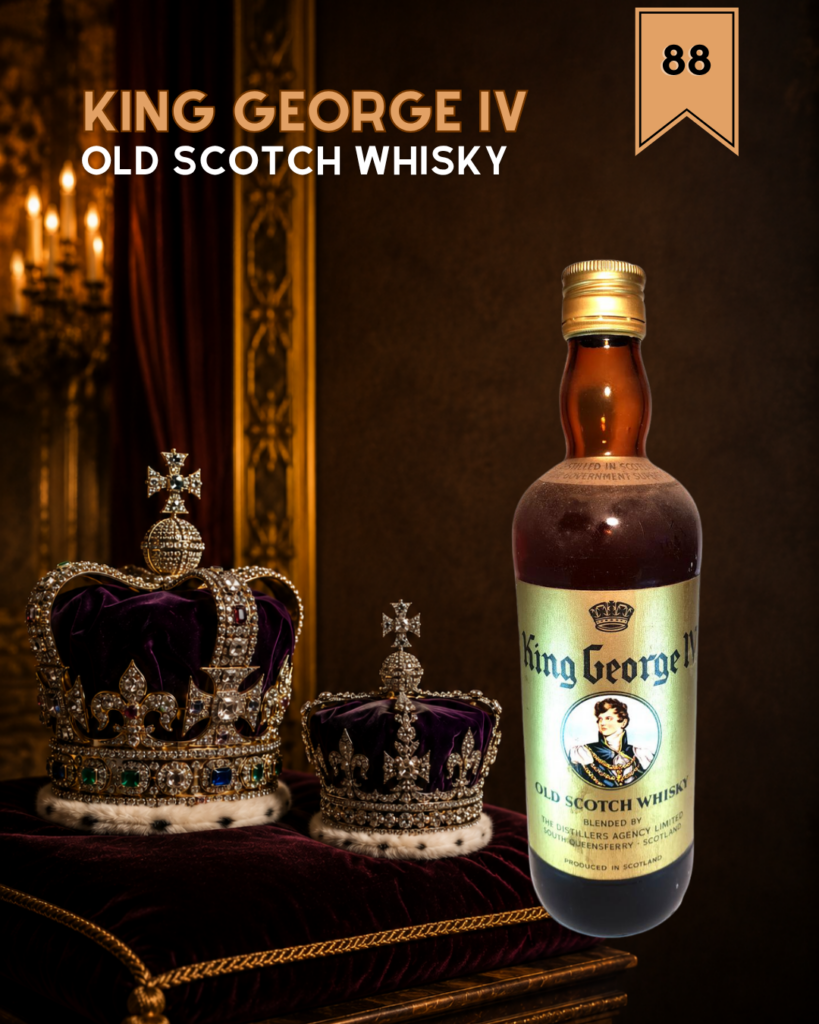
King George IV Old Scotch Whisky, bottled at (probably) 43 % abv
First things first: This King George IV blended Scotch was bottled in the late 1950s or early 1960s. I have found many variants in the Whiskybase, each having a slightly different label or mention, perhaps there is even a difference per market. Mine has no additional labels (like from the importer) so I am guessing my bottle originates from the UK.
Upon Sipping: These notes immediately after cracking (literally) the screwcap open. This is to prevent losing too much of the original whisky to oxidation. Sometimes these oldies reveal their original scent and taste straight after opening, only to then slowly fade into oblivion. The nose is brilliant off the go, with lots of industrial notes (gasoline), beeswax and honeysuckle, hints of mushrooms in a frying pan and, in the depth, a malty fruitiness. Rather complex! After having tasted many old single malts, especially from the Rare Malts Selection, the ghost of the 1960s is undeniably here. Old bookstore, greasy fingers after touching mouldy and dusty shelves. Then a sip. Wow, very raw and unpolished in its power, with a surprising dose of earthy peat (as opposed to maritime peat). Do we catch the old soul of Rosebank here? This does indeed remind me of high abv Zenith Import expressions of this classic lowland single malt. This blend is not for the faint of heart, I promise
Breathing actually does this King George IV blend good, and raisins start popping out of the glass. Then it turns towards a car workshop. I find myself thinking about St. Magdalene malt.
Back again to sherried notes, very old Osborne Medium Dry like my grandmother used to drink. Can you imagine rolling out big, juicy, wet sherry butts onto the quay in South Queensferry? It will smell like this Scotch! A new sip shows signs of losing control, with a slightly more metallic note. Sixty years in the glass is a long time, however well kept this bottle might have been.
A little water reveals that the malt content of this blend must have been above average, because it swims gracefully, and remains dignified on the nose. More sherry fruitiness now. Smells of fresh rain fallen on the banks of the canals in Birmingham. You would half-and-half expect a member of the Peaky Blinders to jump out of the shadows and rob you. This is the good, nostalgic stuff. The taste turns more frivolous with a little water, so that is good. The tired metallic note is gone again. A waxy mouthfeel takes its place, and a creamy vanilla and strawberry now linger on the tongue, even after swallowing. The finish became velvety. And then there is this harsh, alcoholic kick that reminds you: this is pure whisky! You can imagine Don Draper drinking this stuff, right before coming up with a new advertisement.
Word to the Wise: This King George IV Old Scotch Whisky walks a tight line, but the balance act pays off. This is a remarkable old whisky, that preserved the taste from around sixty years ago perfectly well. Lots of old style notes, from floor-malted peated barley, worm tubs, and wet casks, inside and out. However fragile it is, the balance is kept by a good selection of malt whiskies in this recipe, I am sure. The soul of Rosebank is strong in this one, but the fierce one, not the more elegant triple distilled character it is also known for. This is a bottle to hunt down!
Score: 88 points.
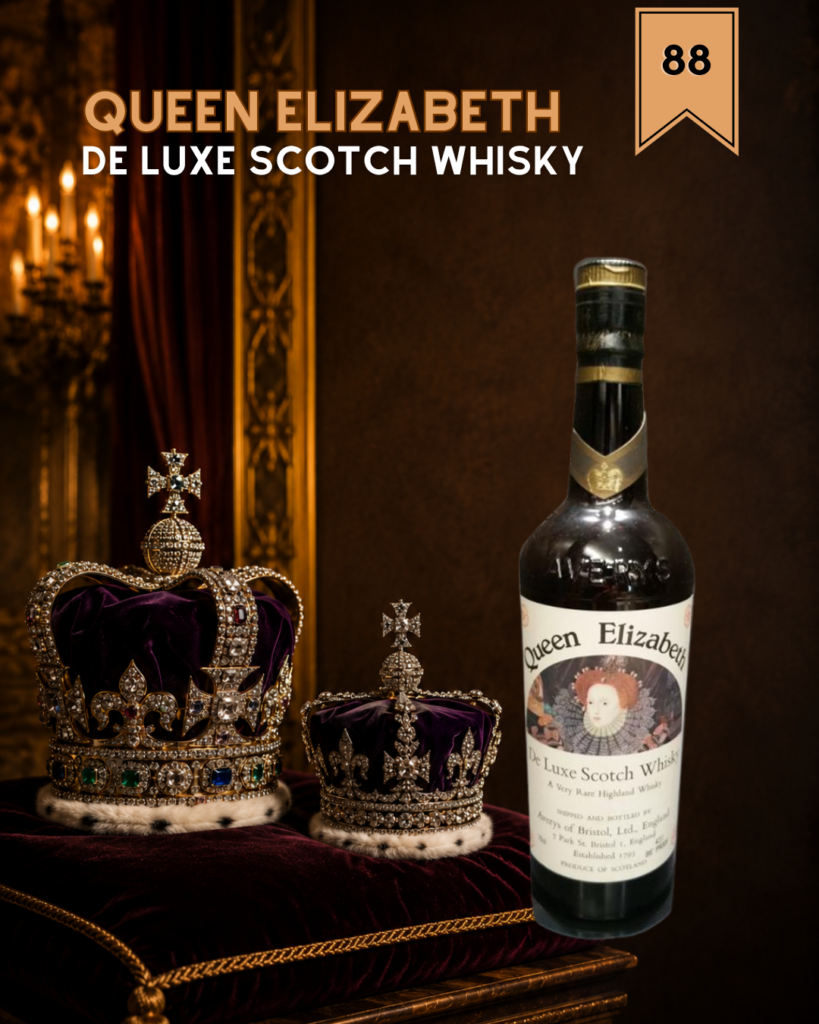
Queen Elizabeth De Luxe Scotch Whisky, bottled at 43 % abv by Averys
First things first: Considering the stopper on this bottle, I think it is a safe bet this is also at least a 1960s bottling. Sample kindly provided by Robbert. “A Very Rare Highland Whisky.”
Upon Sipping: I tasted the above sample right after cracking open the bottle. The Queen Elizabeth whisky was tasting a few weeks later, alongside the King George IV having had some time to breathe, just to see if the whisky survived. The first obvious impression is that of mushy mushrooms, with hints of fruit lying underneath. In fact, on repeated sniffing, the liquid becomes more and more lively, with hints of peaches and apricot. The King George IV remains a more industrial character, with coal smoke and hints of copper. I was present when Robbert cracked (literally) the cork on this whisky, but it remained well-preserved. Then a taste. Very creamy mouthfeel, with soft fruity notes and ultimately an overdose of vanilla. Almost milky, with also some strawberries. Compared to the King George IV, the fruit is more fresh here, where the King has more deepened sherry character. So interesting, because the milky mouthfeel is quite similar. With a drop of water, the Queen Elizabeth actually creeps closer to the character of the King George, with diesel fumes and coal fire swirling from the glass. Then some hints of a dusty attic. The taste becomes even more creamy, but now also some hints of sour milk. The apricots keep the boat afloat. I feel that the grain content speaks a bit louder, with quite a sticky finish. Still, for a blend, it has character aplenty.
Word to the Wise: This was advertised as a Highland whisky, but because of several fruity elements I would not immediately go for that. Unless, well, a nice summer’s day in the Highlands might as well feel like drinking this Queen Elizabeth blend. Well done!
Score: 88 points.