Discovering the Speyside joy of Braes of Glenlivet
Sometimes you just have to fish an odd sample out of the bin, right? Today, we taste a Speyside single malt that always happens to confuse people. That is because of a name change somewhere along the way. You see, Chivas Brothers when it was still called Seagram’s founded the Braes of Glenlivet Distillery in 1973. Production kicked off in October of that year. I wonder what they were thinking with that name, but it was not about marketing, that is for sure. Indeed, the distillery produced mostly for blended Scotch, and does so till this day. No less than 4.2 million litres per annum is the capacity. In 1994, the owner changed the name of the distillery to Braeval, which might sound more familiar to modern ears. It did not bring fortune, as the facility was mothballed between 2002 and 2008. Then the whisky boom exploded like a big bang, and the stills were fired up again. Official bottlings are hard to come by, but a few exist. We, however, taste an independent bottling that still carries the name Braes of Glenlivet. It was distilled on the eve of the name change, I suppose.
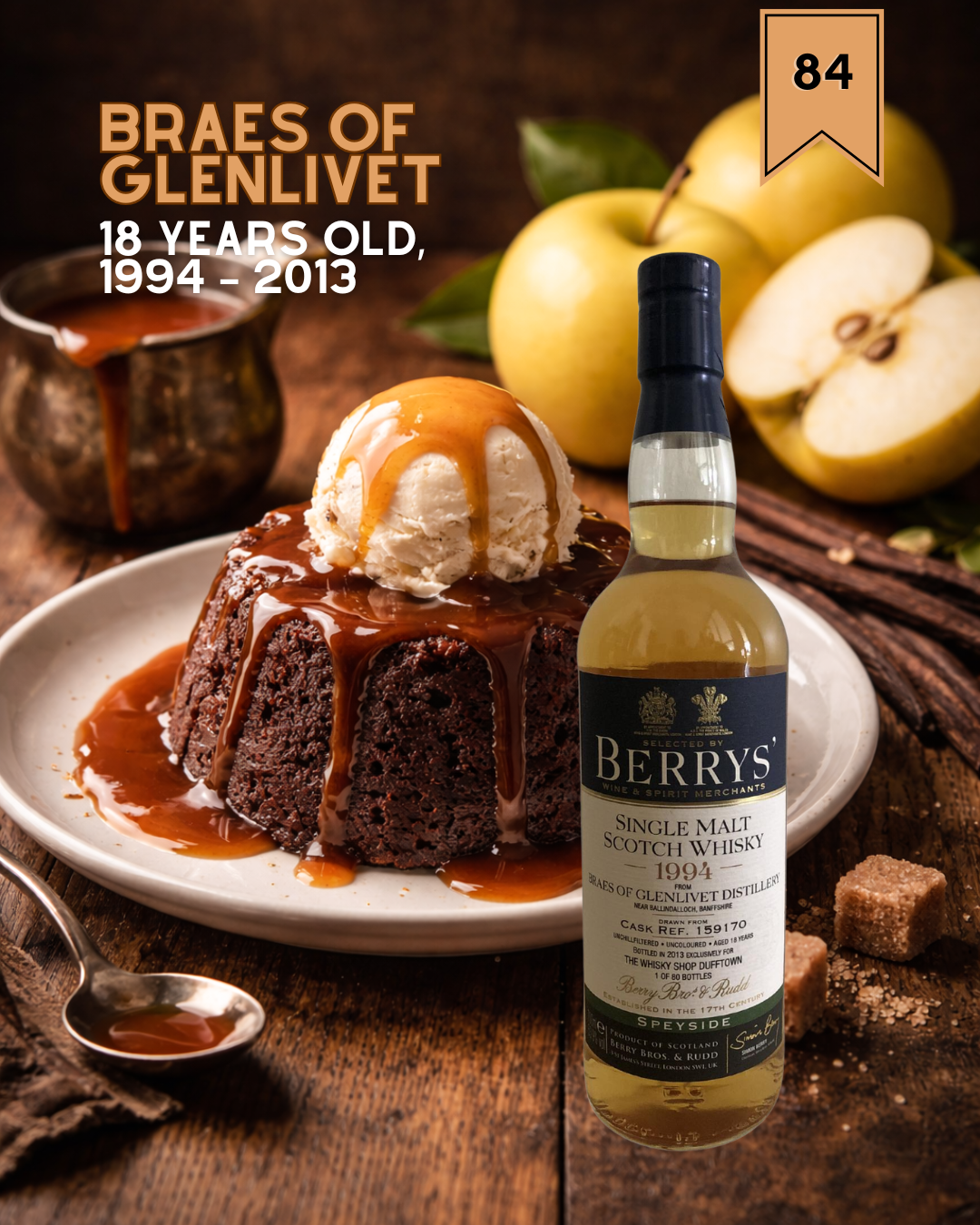
Braes of Glenlivet 18 years old, 1994 – 2013, bottled at 53,9 % abv by Berry Bros & Rudd
First things first: Bourbon cask # 159170 produced 80 bottles for Whiskyshop Dufftown.
Upon Sipping: Not a distillery that I taste often. I also often confuse it with that other name that is heard to remember: Allt-A-Bhaine. Here we go! Classic Speyside in the glass here, or dare I say, classic malt from the Glen of Livet? The bourbon cask is present, with light gummi candy, vanilla in abundance and some minty notes. Balanced and pretty. The taste is very rich, in sticky toffee and creamy vanilla. Quite hot too, with delicate wood smoke and a burning eau-de-vie sensation on the finish. Yellow apples to the fore. Water turns the experience more mossy, with tree bark and wet grassland. It is still my dream to walk the Speyside Way in this part of Scotland, passing the distilleries everywhere. This whisky invokes the image. The creaminess remains, also when diluted, but the taste has lost some of its sparkle. The wood gives a bitter edge. Best to avoid water.
Word to the Wise: A very classic example of a decent Speyside single malt, leaning heavy on the wood, while the spirit plays a role too. Nothing spectacular, just extremely quaffable.
Score: 84 points.