The Burnobennie Distillery and the Case for Fragmented Distilling
Whether you’ve been in the whisky game for decades or you’re just wandering in, chances are you have a favourite. This brand, that age statement, you name it. To legally call itself whisky, a spirit has to spend at least three years in an oak cask, which means that even the youngest whisky you’ve ever poured has, at minimum, matured. My visit to the Burnobennie distillery deepened my thinking about New Make Spirit. A conversation with Development Director Sam Ritchie will do that to you. Read on and see what I discovered.
Text and photography: Tom van Engelen — www.longpouramour.com
I probably hold New Make Spirit in higher regard than most whisky lovers do. On my blog I have reviewed and scored several distilleries’ unaged spirit, and I don’t see why I shouldn’t. If a distillery decides to sell New Make Spirit commercially, then we are entitled to have an opinion about it. But for the brands that take that step, you can wonder: is it genuine belief in the category or just a way to bridge those first three years and squeeze a little revenue out of the wait? In June, I visited the Burnobennie distillery in the small town of Banchory on the River Dee, about half an hour’s drive from Aberdeen. If that conjures any romantic notions, drop them immediately. Burnobennie occupies units 10 through 14 of a business park, the kind you’ll find by the thousand anywhere in the world. Burnobennie is fully licensed to distil, mature and even sell on-site, with a Kwik Fit back down the road, a Screwfix a little further along. And yet, the moment Sam Ritchie welcomes me, I catch the unmistakable soul of whisky in the air.
From Michelin Stars to Whisky
Burnobennie’s origin story is a little hazy. The operation grew out of an earlier project, the Deeside distillery, about a mile down the road, where rum, gin and beer were once made. The earliest experiments with malted barley there could only be labelled as ‘single grain whisky’, since the spirit wasn’t run through copper pot stills. That has since changed, and Burnobennie was born from it. Almost every cask of Deeside whisky filled during that roughly five- to six-year production run has since been sold to private buyers – proceeds that gave Burnobennie a flying start. The name nods to a local stream, the “Burn o’ Bennie”, which I did in fact cross on the way in.
Sam Ritchie joined the team in 2023 with no background in distilling, yet he sees plenty of parallels with his previous life. He worked as Senior Sous Chef at The Five Arms, the world-famous five-star hotel in Braemar whose kitchen carries not one but two Michelin stars. The Ninth in London is also on his CV. Sam reads flavour profiles like few others can, and it’s exactly that skill he brings to bear as the mash tun, washbacks and stills at Burnobennie simmer away like pans on a stove. “You can approach whisky scientifically,” Sam tells me. “The playing field is tightly framed. You’ve only got three ingredients – water, malted barley and yeast – so our products are fully traceable. We take our water straight from the tap here; the quality is perfect. We are careful about where our grain comes from, and we want to do more with yeast still. After that comes cask management. We have a good working relationship with the Speyside Cooperage, and we mature mostly in oloroso and PX casks. A lot of our distilling is done on contract for clients, and once we’ve delivered to them, they’re free to experiment with their own casks.”
Playing at the Edges
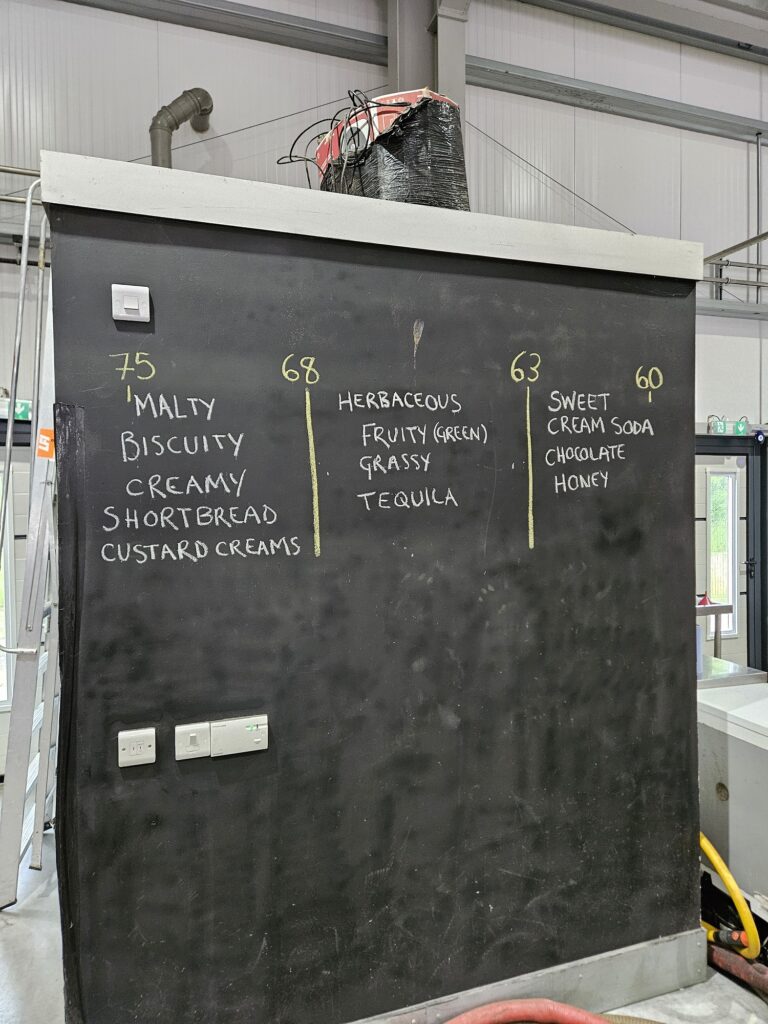
With Sam’s arrival, Burnobennie’s output seems to be finding its footing. The standard run has settled around a whisky built on Pale and Crystal malt with a portion of Chocolate malt, which is a darker roasted grain. Fermentation typically runs five to seven days and is allowed to fully settle. Sam uses a high-gravity fermentation technique, pushing the wash’s alcohol content higher than is typical in the industry, to somewhere between 12 and 14 percent. “That gives you both positive and negative flavour components. What I am chasing during distillation is a fruity, malty, almost biscuity profile,” Sam explains. “What I find really interesting is what I call fragmented distilling. Different cut points give you different flavours.” Sure enough, one wall has been turned into a black chalkboard mapping the different flavours against the different alcohol strengths. Sam cuts mainly between 75 and 68 percent, since that is where the profiles he’s after tend to show up. “Then, between 68 and 63 percent, you get something grassier – herbal, green fruit, I even describe it as ’tequila-like’ because it reminds me of it. After 63 percent there’s still something worth taking, sweet, cream soda, honeyed, but around 60 percent it’s over. You want to avoid dragging the tail into the heart. If that costs you on total yield, so be it.”
Fermentation gives away almost as much as the cuts do. In the first one to three days, the CO2 coming off the washbacks smells tropical and fruity; by days five to seven it turns sulphur-like, comparable to an egg sandwich from the supermarket round the corner, which is generally a sign fermentation is coming to an end. “From a cut perspective, we take enough of that bottom end of the hearts to keep the spirit in profile, without taking so much that it compromises the flavour.” Cherry pie and banana notes Sam is chasing, meanwhile, don’t come from the cuts at all. “Those esters came out of our yeast trials, samples of which we have lined up at the back of the distillery. We are seriously working on different yeast strains that create stronger esters, and that’s very much a step we are still evolving.”
The Distillery
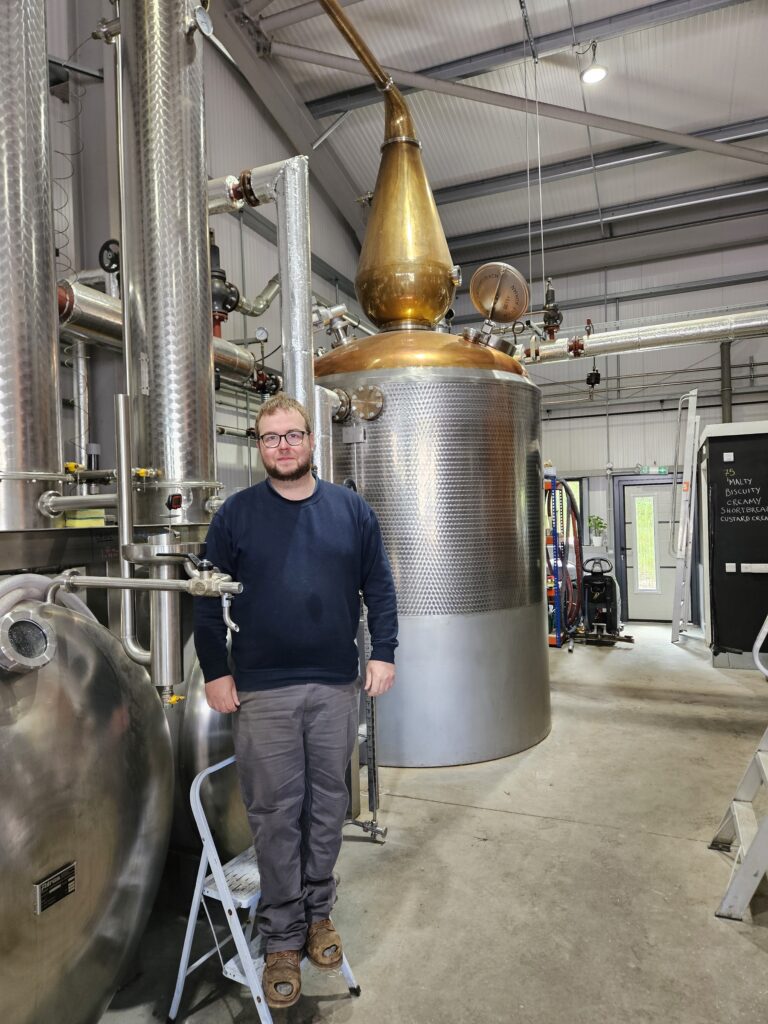
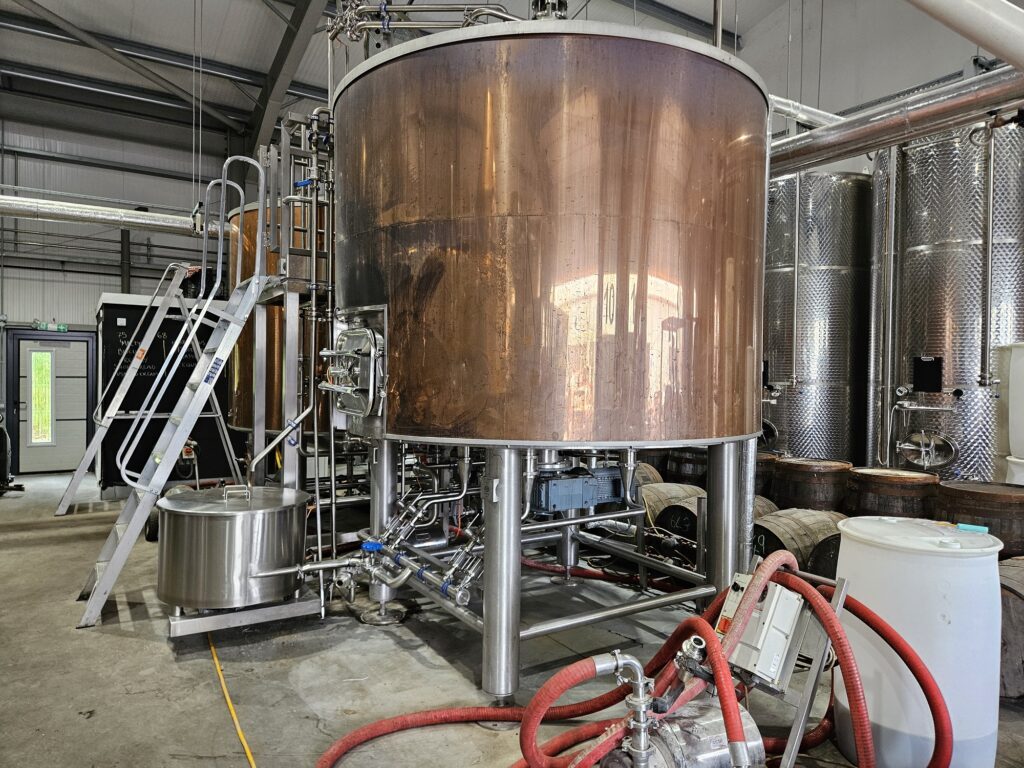
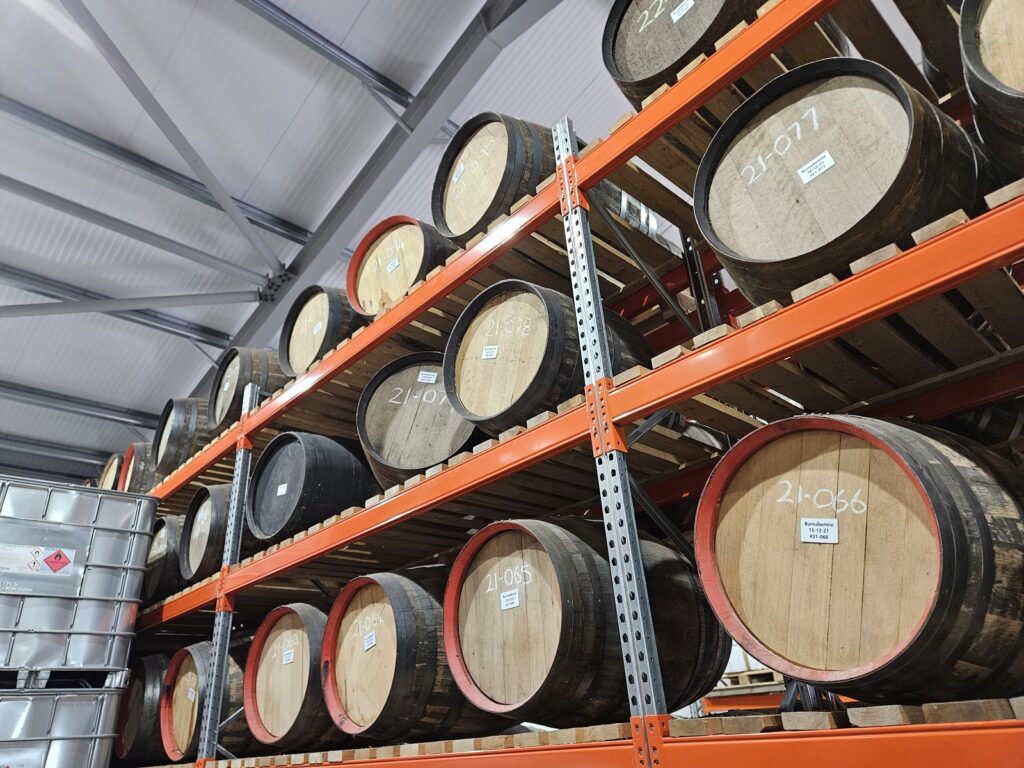
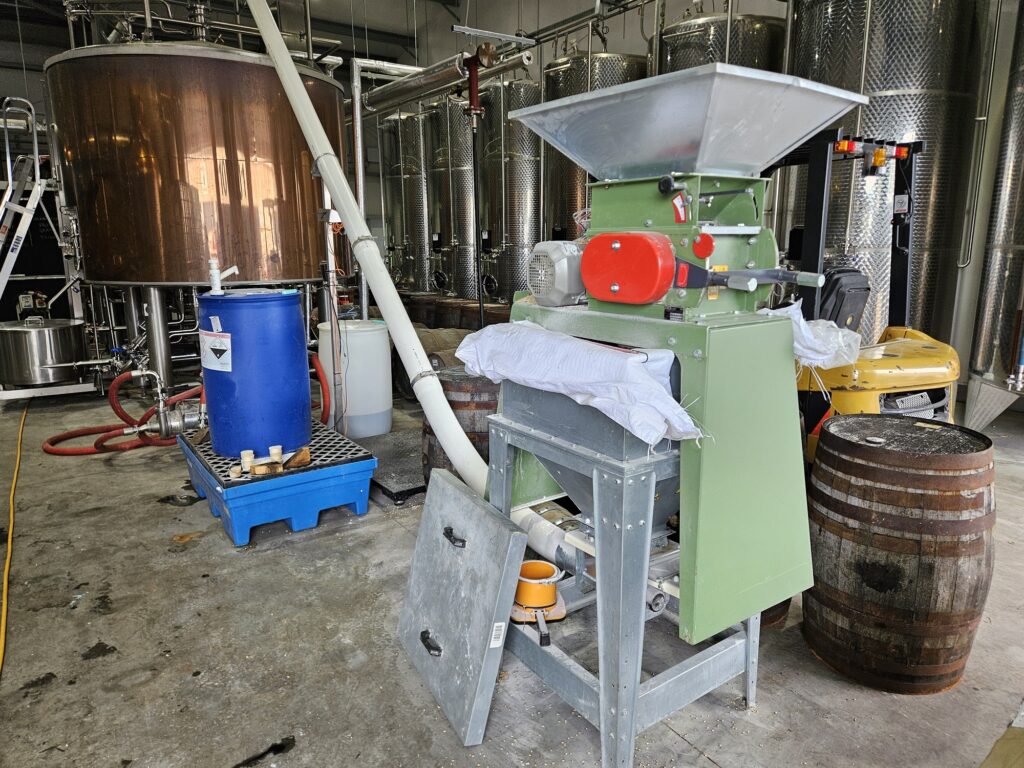
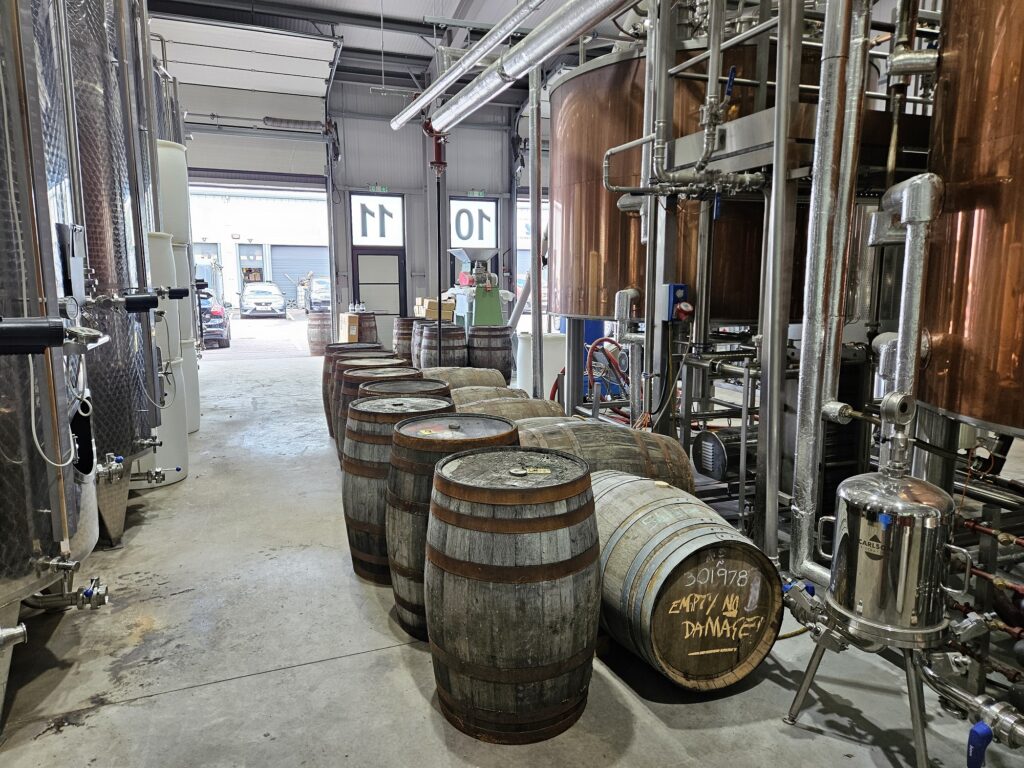
The distillery reveals itself at a glance: a compact mash tun with a small underback. Burnobennie runs nine washbacks, two of which are currently used to collect the New Make Spirit. With a 5,000-litre wash still named Betsy and a 3,600-litre spirit still awaiting its name in view, Hudson. Both are German-built, made by Adrian Edelbrände GmbH in Großheubach. Distillation is slow, running at roughly 6 to 8 litres per minute. “I like to keep the stills at a stable, cool temperature, so the cooler vapour gives you a stronger spirit. We make enough for five casks a day. I only distil whisky when it’s not too warm outside, otherwise there’s no point.” Fortunately, Scotland is rarely extremely hot, unlike an increasing number of places elsewhere in Europe these days. Either way, some 1,200 casks are filled and maturing either a door down or in a separate warehouse, also based in Banchory.
A Passion for Peat
Sam pulls out his phone, and for a moment the calm, professional exterior slips to reveal a flash of unfiltered passion. On the screen: a home-built malting drum where he runs his ‘peat trials’. The thing looks like a war machine dreamed up by J.R.R. Tolkien. The grain is pushed to a striking 80 PPM, spun for six hours in the drum and then left to ‘sleep’, as Sam puts it. He dreams of a new age for peated malt whisky – locally cut peat, hands-on processing from the ground up. “I would genuinely love to release this as a peated Burnobennie expression, alongside a more regular single malt that we’ll probably keep a little more anonymous. I’ve filled some sample bags and sent them out to existing customers. The response has been positive.” Several New Make Spirit samples make their way into my suitcase too, bound for the Netherlands. “Let me know what you think of it!” he calls after me as I head for the car. My fingers smell of peat, as if I’d taken a turn in the kiln myself. Burnobennie couldn’t care less about convention – and in doing so, brings real Scottish tradition roaring back to life.
A New Way to Read New Make
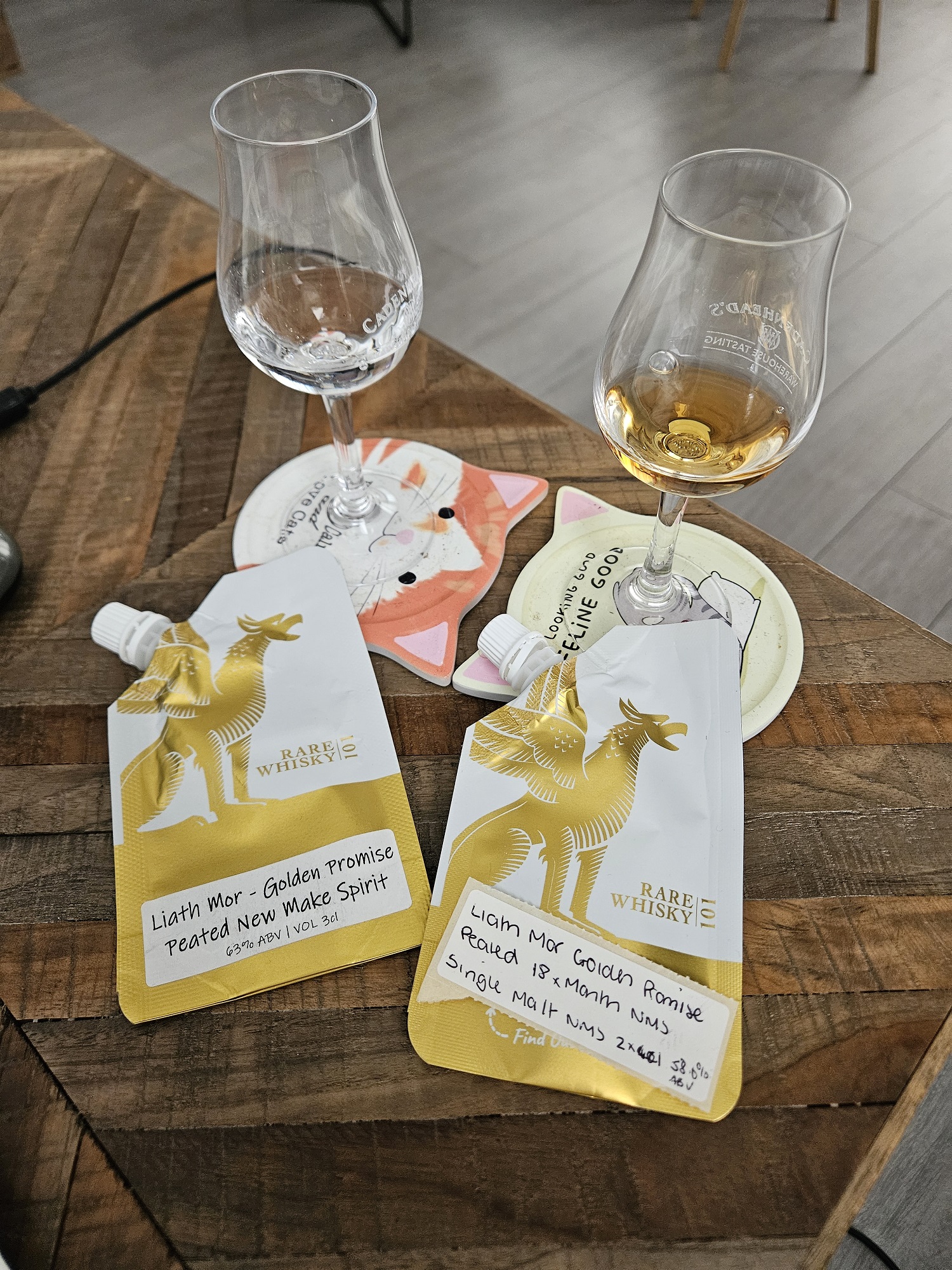
Conversations like this one with Sam are exactly why I have never been able to treat New Make Spirit as a footnote. It is raw, yes, but it is also the clearest window we get into a distiller’s intentions before wood and time start editing the story. Sam’s fragmented cuts, mapped out in chalk on that wall between 75 and 60 percent, are basically a masterclass in exactly the kind of decision-making I’ve been trying to put into words on this blog for a while now.
Which brings me to something new: The New Make Index, or NMI. This is a scoring framework I have built specifically for evaluating New Make Spirit on its own terms, rather than pretending it is an unfinished whisky. Three axes, each scored 1 to 5: Purity, Character and Potential, read together as a single score like NMI 4/3/4. It’s my attempt to give raw spirit – spirit exactly like the samples that came out of my suitcase when I came home – the serious, structured attention it deserves.
I will be running Burnobennie’s New Make Spirit through the NMI in a separate blog the day after tomorrow, cut by cut. In the meantime, you can read the full framework and find out exactly how the scoring works on the blog, which will be published tomorrow. Sam, when you are reading this: I will let you know what I think – you will just have to wait for the numbers.