Tasting a classic and fiery Rosebank 1981 RMS
Finally we have a bottling in the famed Rare Malts Selection on the table again. It is a special one, as it was distilled at the Rosebank Distillery. As we all know, this lowland region producer of triple distilled malt via wormtubs got a new leash of life a few years ago. In fact, my mailbox was recently graced with good news. I will quote the mail, sent in early July: ‘On 19 July 2026, Rosebank reaches a milestone that once seemed unimaginable. Three years after Cask 001 was filled at the revived distillery, the spirit laid down following Rosebank’s return, officially becomes whisky. For Rosebank, this is more than simply a legal definition; it represents something much greater. To mark this milestone, Distillery Manager Neil Bulloch and former Distillery Manager Malcolm Rennie revisit Cask 001, exploring the aromas, flavours, and character emerging after three years of maturation. Watch the film to discover why the future of Rosebank is already showing such promise.’
After this free commercial (I promise I have no ties to Rosebank, just a massive fan of the malt whisky produced there in the past), we get on with the business of our weekly “Long Pour Session”, in which we do a deep dive on a particular glass. Today, as said, a bottling in the legendary Rare Malts Selection. If you like to read a modern take on Rosebank, be sure to check out my distillery visit of almost two years ago here.
The Rosebank Distillery was established in 1840 by James Rankine, who converted the maltings of the Camelon Distillery into a new production site. With that in mind, we can trace distilling on the location back even further, to as far as 1790. This was the year that the Forth & Clyde canal was opened. It became a lifeline inbound and outbound of Falkirk, where Rosebank is located just west of. The ties with the Rankine family grew strong, as James and later his sons would run Rosebank for decades to come. It became so important that the distillery was a founding company of the SMD (Scottish Malt Distillers).
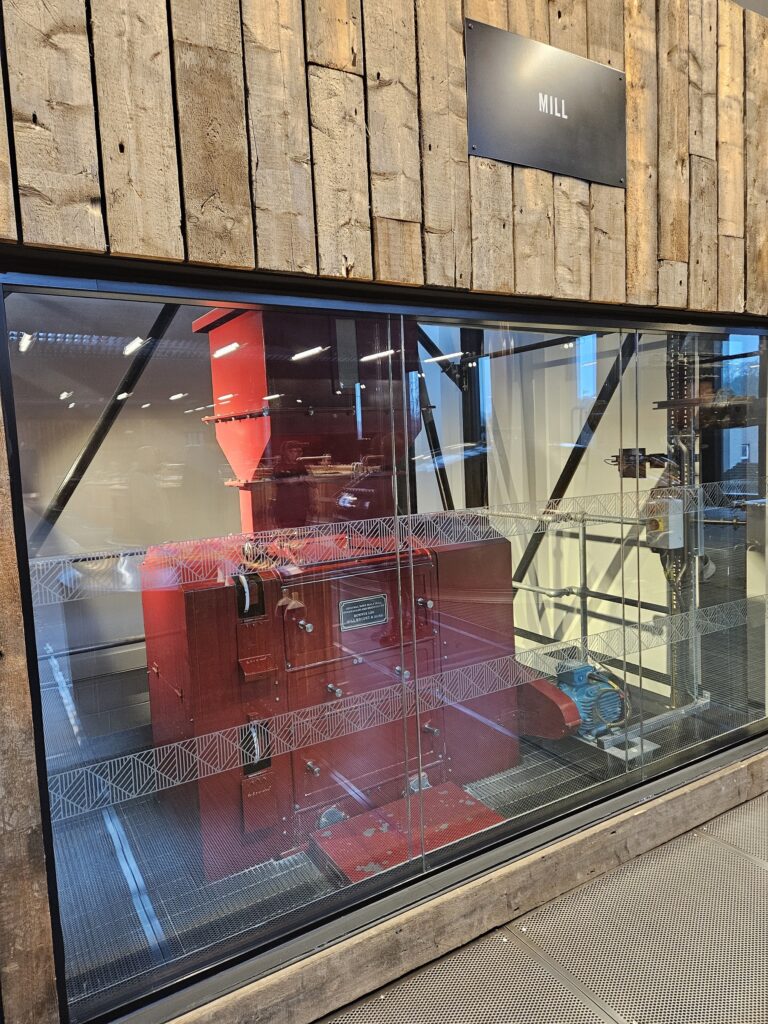
Boby Mill of Port Ellen
Technically, there are some interesting features about the old Rosebank distillery, besides that triple distillation took place there. For instance, Rosebank operated a Morton’s refrigerator to cool the wort. The Boby Mill at Rosebank is an original from the Port Ellen Distillery, and is still in operation today! I tried to uncover why a contradictory technique of triple distilling (lighter spirit) and cooling with wormtubs (resulting in heavier spirit) was implemented, but historians that I could source did not leave a clue. Modern day takes on it are quotes I could find from brand ambassador Gordon Dundas (calling it a ‘juxtaposition in whisky production’) and (former) distillery manager Malcom Rennie, calling it a ‘somewhat nonsensical jigsaw puzzle’. My best guess: it was once done like this, and never changed, resulting in the famous description for Rosebank spirit as ‘an iron fist inside a velvet glove’.

Rosebank was one of the few distilleries to actually be in production during World War II. After 1968, Rosebank seemed to have been neglected by its owners. There do not seem to be any records of works, besides the demolishing of the maltings that were there from the Camelon Distillery days. Somehow, it escaped the big closures done in the 1980s, which saw names like Port Ellen and Brora disappear. In 1993, the hammer still fell on Rosebank, together with Bladnoch, Pittyvaich and the Cambus grain distillery. Luckily, some of these ghost distilleries are now “survivors”. Rosebank among them. Better than ending up as a Beefeater restaurant, eh?
Stolen stills
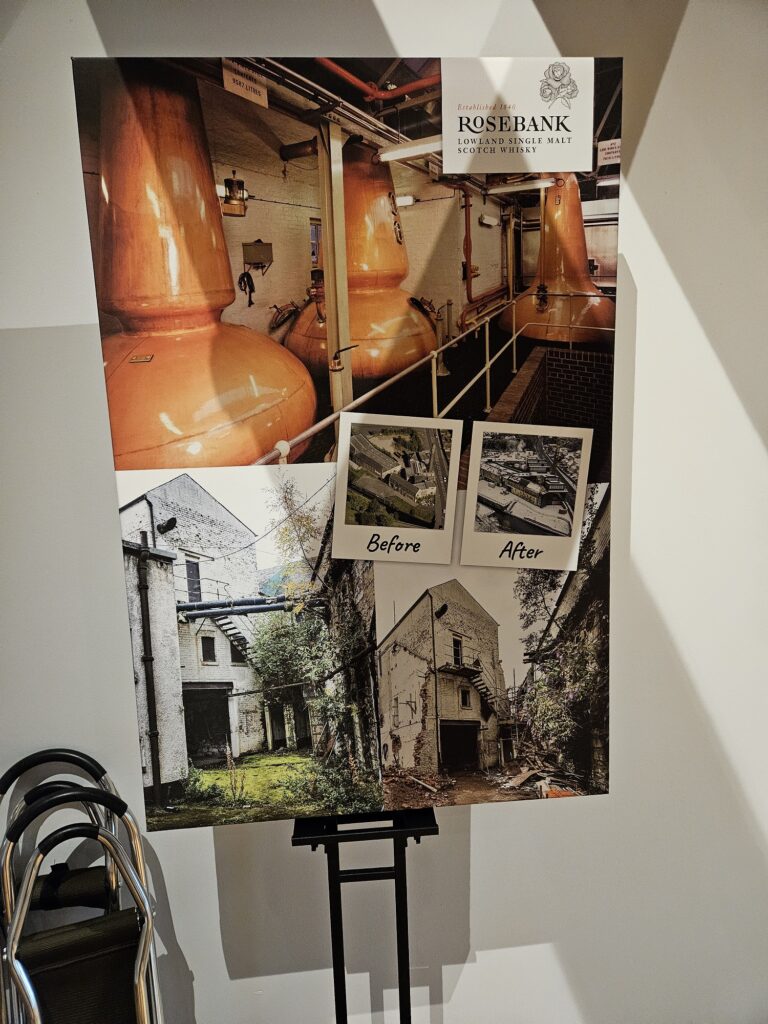
A particularly dark chapter in the history of Rosebank occurred mere days after Christmas 2008. Although silent, the stills of the distillery were kept in place on location, maybe always keeping a spark lit on the revival. But with copper being as valuable as gold, and much easier to find, thieves cut apart the stills and sold them for scrap. To me, it always seemed the final nail in the coffin of Rosebank. Luckily we learned that even from the deepest abyss a soul manages to rise. Let us celebrate with whisky that was actually made in those stolen stills!
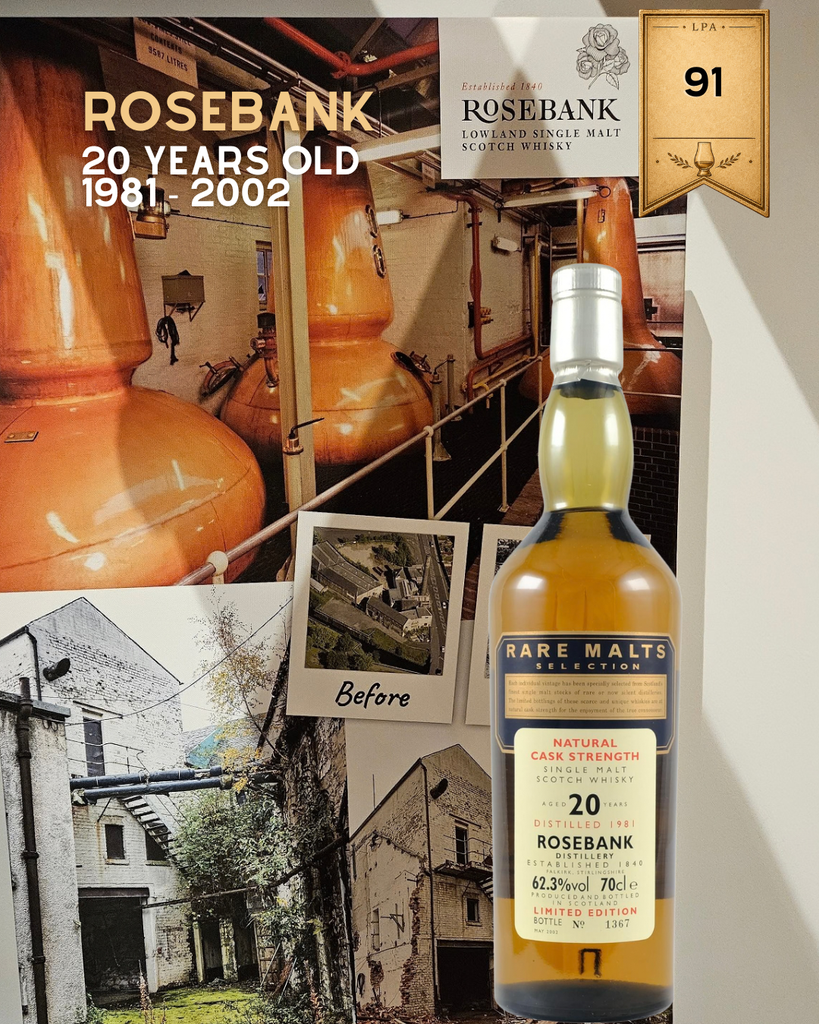
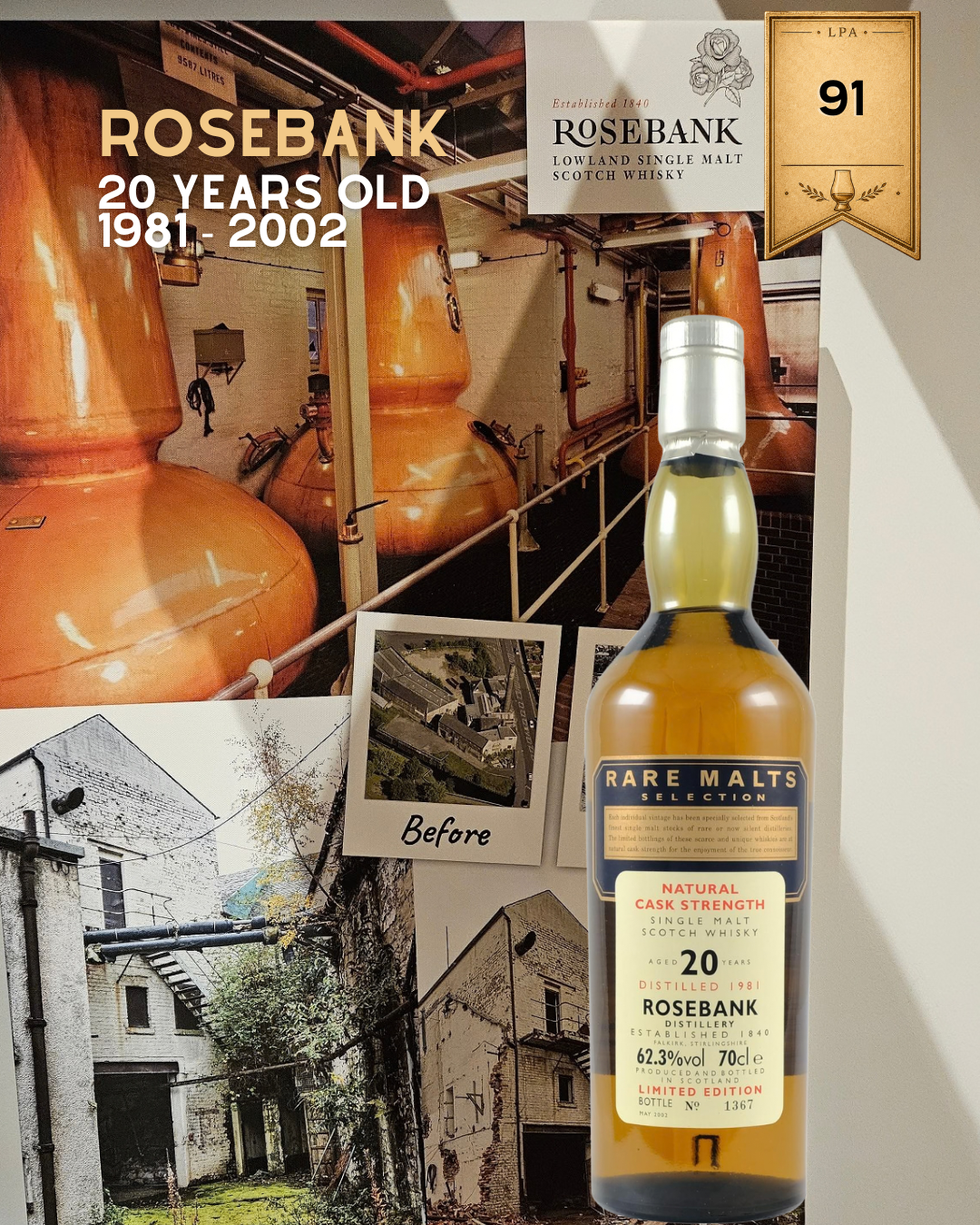
Rosebank 20 years old, 1981 – 2002, bottled at 62,3 % abv
First things first: Bottled in May 2002 in a batch of 6.000 bottles. According to Ulf Buxrud in his standard work about the Rare Malts Selection, Rosebank was always on a maturation scheme for (first) an 8 years old, later a 12 years old. A mix of refill bourbon casks and sherry butts were used. Rosebank was famously used in King George IV and Swing blends.
Upon Sipping: Just waving this Rosebank under the nose, not too close by to protect us from the extreme abv, is a joy to experience. Lots of waxes, lemon juice, grapefruit. Beautiful woodland whiffs, freshly cut staves, the sawdust still on your hand. Warm and summery. There are some hints of fruit, like lychee and white grapes. Perhaps a peach for good measure. We will return to the nose after adding some water. The arrival on the palate begins sugary sweet, before a fierce hot flare shoots up and down your mouth. This is pure power that one does not easily find in today’s cask strength whisky anymore. Somehow it is full of taste, quite fruity actually, with stone fruits to the front. Some white pepper makes for a punch but yes, you could drink this straight up, especially if you have warmed up the palate for the arrival of such a giant (for the record: I did not for this tasting session).
Upon Sipping: Just waving this Rosebank under the nose, not too close by to protect us from the extreme abv, is a joy to experience.
Lots of waxes, lemon juice, grapefruit. Beautiful woodland whiffs, freshly cut staves, the sawdust still on your hand. Warm and summery. There are some hints of fruit, like lychee and white grapes. Perhaps a peach for good measure. We will return to the nose after adding some water. The arrival on the palate begins sugary sweet, before a fierce hot flare shoots up and down your mouth. This is pure power that one does not easily find in today’s cask strength whisky anymore. Somehow it is full of taste, quite fruity actually, with stone fruits to the front. Some white pepper makes for a punch but yes, you could drink this straight up, especially if you have warmed up the palate for the arrival of such a giant (for the record: I did not for this tasting session).
With a drop of water then. I tried to reduce it to around 50-52 % abv. A strong burst of vanilla and wood splash from the glass now, and it needs time to accept the water. If any sherry butts were used in the vatting of this Rosebank, I would be surprised. After a while we pick up less lemon but more zest, stronger, more together. Perhaps the hint of petrichor, but at the very least some autumn leaves on a wet, mossy forest floor. Whiffs of banana that slowly turns into beeswax. Finally, I wonder if I could use this instead of paraffine to make candles. It is quite amazing, this classic Rosebank, which is a product of a certain era in whisky. Almost painfully simple, or better yet: austere. The firm mouthfeel has not lost any of its potency with the water, but the waxes are ramped up to maximum, always with a sugary lemon mixture. It fits the time of year; this is the perfect dram for Autumn.
Word to the Wise: A true classic that almost puts a Clynelish to shame with the amount of waxes it presents. I have tasted more late eighties and early nineties Rosebank compared to output from this era and before, and those latter day products are distinctly lighter in tone. Old Rosebank is in a league of its own.
Score: 91 points.